Winter Solace in the Grey Corries
Startled, I was shaken awake by a Scottish accent all dressed up in hi-vis.
“Excuse me lad, you can’t sleep here.
I was sitting, slouched, on a bench in Edinburgh Waverly train station. Here I had planned to sleep for the night.
“You need to leave the station lad”.
It was simple, I thought. If my train from Durham arrives into Edinburgh at midnight and my train to Corrour was at 5am then rather than flaking out on a hotel I would acquaint myself with a train station bench. Such is the mindset of a student. A very broke student.
Unfortunately was not the mindset of the grouchy Scot Rail worker, who explained that Waverly was not open 24 hours. Nor was it open to rough sleepers.
“Anyway, what’s a student like you sleeping in a train station for.”
For this I blamed the Met Office. More specifically one of their forecasts. Snow.
I’d always wanted to do the Grey Corries. A friend had done them the previous winter. He described them as ‘mega’, and recommended a nearby bothy too.
Named for the pale grey scree and quartzite rock that stripe their corries and ridges, the Grey Corries are a mountain chain that lie just to the east of Ben Nevis. Comprising four munros, the Corries were on my tick list.
So when, during a particularly dry lecture on the thermodynamics of the Krebs cycle (boring biology degree stuff), I was briefly flicking through the forecasts of various mountainous areas of the country (I am a hill walking nerd) and I saw snow in the Corries I binned off my degree-related plans for the weekend.
The logistics were simple.
Get a train to Edinburgh, then the Caledonian sleeper to Corrour early Saturday morning. From here I would walk 9km north west along a double track to Loch Treig. I would then ascend Stob Coire Easain and Stob a’ Choire Mheadhoin, the two munros rising from the shores of the glacial loch. After these I would then descend to the west and overnight in Lairig Leacach, a small bothy. This would place me at the foot of the Corries which I could then tackle on the Sunday.
First however, I had to find somewhere to sleep.
Edinburgh is much less touristy at 12pm on a brisk February night. Especially a Friday. The locals were out in force, and they were clearly enjoying themselves. Except for the chap with his face bashed in. Neither he nor the police looked much too happy.
Therefore finding a quiet corner to hide away in with my sleeping bag proved difficult. A number of promising spots turned out on closer inspection to be already occupied. Either by rough sleepers, or drunkards, or crack heads. Sometimes all three. None gave me the impression that they’d be happy sharing
So this was how I found myself on the elevated stone platform outside the Scottish National Art Gallery, tucked inside my sleeping bag. Surprisingly it was the quietest area I’d found all evening. I managed a few hours of sleep before heading back to the now open Waverly. I had a train to catch.
The Caledonian sleeper delivered me to Corrour. And as the sleepers midnight teal livery said goodbye I took a look around. I had a grin on my face.
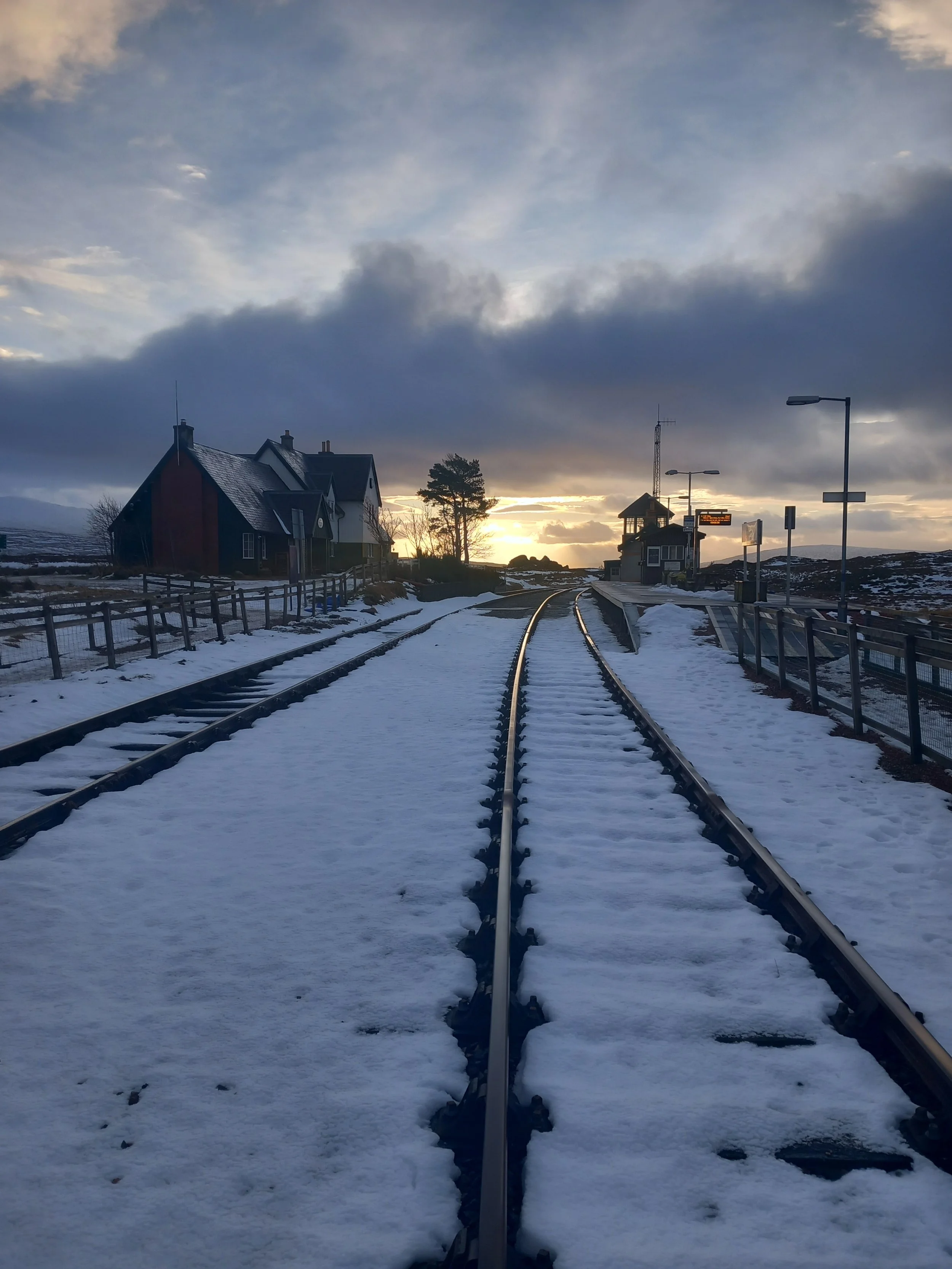
Snow paved the gently curving train tracks, the sun peaking over the horizon. The sky was reasonably clear too, a patchwork of blues and whites. Corrour house stood opposite me. Alone.
Corrour is the highest train station in the UK, at 400m. It is also the most remote, sat in the middle of Rannoch moor deep in the Scottish highland, with no road access. In my mind this makes Corrour very cool. Very cool.
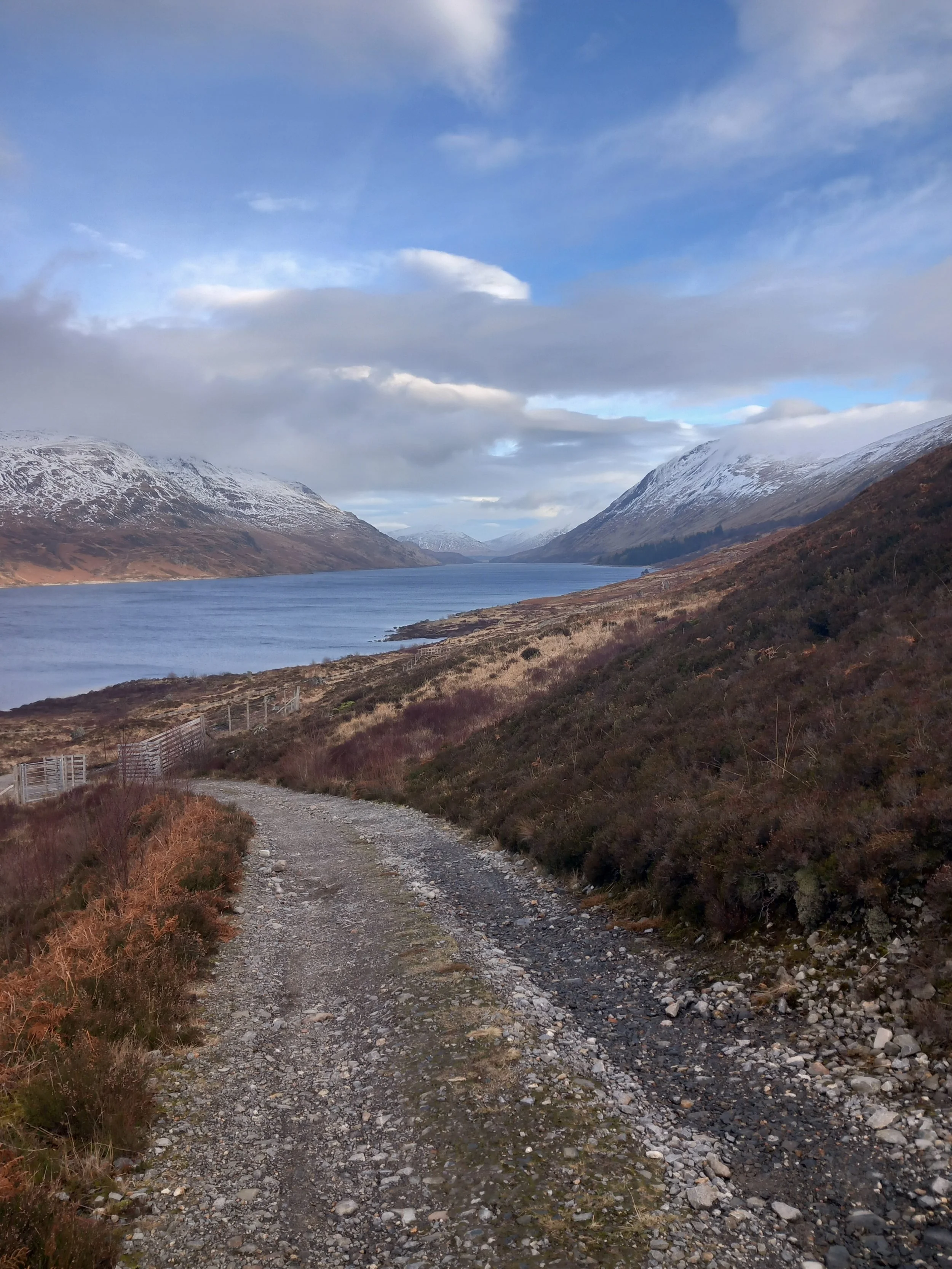
So naturally I started walking away from it. I followed a double track roughly north-west for 4km or so until I reached Loch Treig. As you can see from the photo the views were marvelous and the sun was out. This changed however as I tackled the day's objective: Stob Coire Easain (1150m) and Stob a’ Choire Mheadhoin (1105m). At about the 700m mark the weather changed as is typical when you’re having a good time.
White.
White, white, white.
SOooo much white.
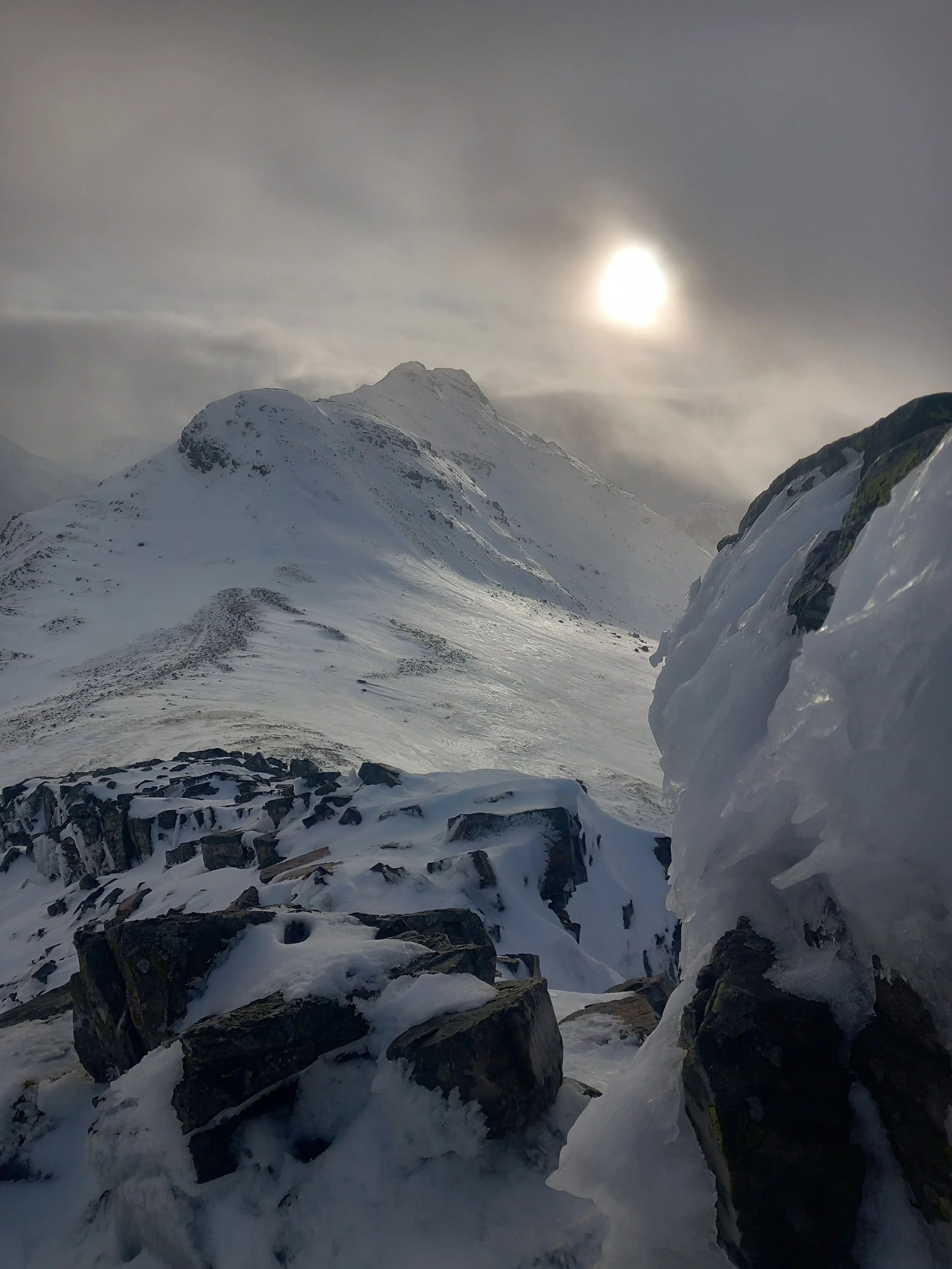
I was in a white out. Ski goggles now on and using my compass I found the pile or rocks marking the top of Stob Coire Easain. Or at least what looked like them. By this point the white out was so bad I was starting to become dizzy every time I looked up from my compass and saw only a mosaic of shifting whiteness.
Following the ridge around to Stob a’ Choire Mheadhoin proved tricky and I was concerned about the cornices that I couldn’t see. But this all went smoothly and I acquainted myself with another vague summit. However, the descent down into the valley was… less smooth.
The Scottish Avalanche Information Service or SAIS issue general reports on what they think the snow conditions will be like in the various mountain ranges of Scotland. The idea being that people might read these before they go out, along with a weather map and other forecasts, so they make sensible decisions. Being sensible I read this
So I knew that in the Lochaber area (where I was) there was a moderate risk of wind slab on north-west facing aspects. My ascent had been by the south so I had avoided these. But the quickest route to descend to the valley to reach the bothy was down a north west aspect. It just so happened that this had a slope aspect of around 35 degrees, in the “sweetspot” for human triggered avalanches.
After nearly triggering an avalanche I decided that despite being tired and dizzy I would instead take a longer route to the bothy navigating shallower slopes on a westerly rather than north-westerly aspects. I didn’t find any wind slab here.
Fortunately as I came into the valley the cloud had lifted a bit and I could see my spot for the night. Lairig Leacach.
A low, stone rectangle, tucked almost apologetically into the landscape. No lights, no noise, no sign of life. Just a door, a chimney, and the vague promise of shelter. After a day of navigating whiteness, it looked perfect.
Inside, it was as you’d expect. Cold. Damp. Smelling faintly of smoke and something older—peat, maybe, or just years of passing walkers. There were two raised sleeping platforms, a scattering of old tins, and a hearth blackened from countless fires. Luxury, by the standards of the day.
I dropped my bag with more relief than grace, peeled off the outer layers stiff with frost, and got a fire going with the limited dry wood I could find. The small flame did little to warm the room, but psychologically it made all the difference. This was home now. At least for the night.
Dinner was functional rather than enjoyable—something dehydrated and vaguely pasta-adjacent—but I ate it quickly, aware of how tired I’d become. The kind of tired that seeps into your bones after a long day of concentration more than exertion. Navigation in a whiteout demands a particular sort of focus, and I could feel the aftereffects.
Lying in my sleeping bag, I listened to the wind pick up outside. It rattled lightly against the stone walls, a reminder of how exposed the Corries would be tomorrow. The original plan—to tackle all four Munros in one clean sweep—now felt… optimistic.
Still, that was a problem for the morning.
When I woke, the bothy was brighter than expected. Not sunny, exactly, but clear enough. The wind had dropped, and the oppressive blanket of white from the previous day had lifted into something more forgiving. Layers, not void.
Encouraging.
I packed quickly, stepping back outside into the cold. The Grey Corries stretched ahead, their ridges sharp and pale against the sky. Proper mountains now—visible, defined, and, crucially, navigable.
The ascent onto the ridge was steady, if unremarkable. Legs a little heavy at first, but finding rhythm soon enough. As height gained, the views opened out behind me—Loch Treig now a long, dark ribbon cutting through the landscape, yesterday’s route etched faintly along its edge.
By the time I reached the first summit—Stob Coire an Laoigh—the contrast to the previous day couldn’t have been greater. Where there had been only disorientation, there was now clarity. Peaks, ridgelines, cornices—visible, avoidable. The kind of conditions that make you forget, briefly, how quickly things can turn.
The traverse along the Grey Corries ridge is what my friend had meant by “mega.” Narrow in places, broad in others, always exposed, always interesting. Snow clung to the northern edges, sculpted by the wind into overhanging cornices that demanded a bit of respect—and a slightly wider berth than felt natural.
But it was good. Really good.
A kind of quiet focus took over. Step, plant, check. Repeat. No whiteout-induced dizziness, no second-guessing every bearing. Just movement along a line that made sense.
By the time I reached the final Munro—Sgurr Choinnich Beag—the light was beginning to soften, the sun dropping lower behind a thin veil of cloud. Four summits, done. The full line of the Grey Corries, ticked off.
I allowed myself a brief pause at the top. Not long—February doesn’t lend itself to lingering—but enough to take it in. The ridges stretching back, the bothy hidden somewhere in the valley beyond, Corrour far off in the distance.
It hadn’t gone exactly to plan. It rarely does. But that was, I was starting to realise, part of the appeal.
The descent was long but straightforward, snow gradually giving way to rough ground as I lost height. By the time I joined the track to Spean Bridge train station, the light was fading properly, and the temperature dropping with it. Once on the train I slept my way back home.